

Poor communication is one of the most expensive and preventable problems in the construction industry, yet most companies don’t measure it, and even fewer solve it strategically.
If your projects are coming in over budget, behind schedule, or requiring costly rework, the root cause may not be what you think.
In this blog, we’ll help you address the communication issues that can arise in construction projects.
You might also like: Why Construction Companies Are Hiring Assistant Project Managers in 2026
The Real Cost of Poor Communication in Construction
Before blaming labor shortages or material delays, consider this: a PMI study found that poor communication is responsible for one-third of all construction project failures, where “failure” means a cost or schedule overrun, or both.
The financial impact is staggering. Communication breakdowns generate over $177 billion in excess costs annually in the U.S. construction industry alone. And according to McKinsey, 95% of construction data goes unused, leading to miscommunication and delays that drive budget overruns averaging 28%.
These aren’t edge cases. Cost overruns affect a staggering 98% of construction projects globally, often averaging around 80% above initial estimates.
The good news: communication failures are fixable. Here’s where they typically occur and what you can do about them.
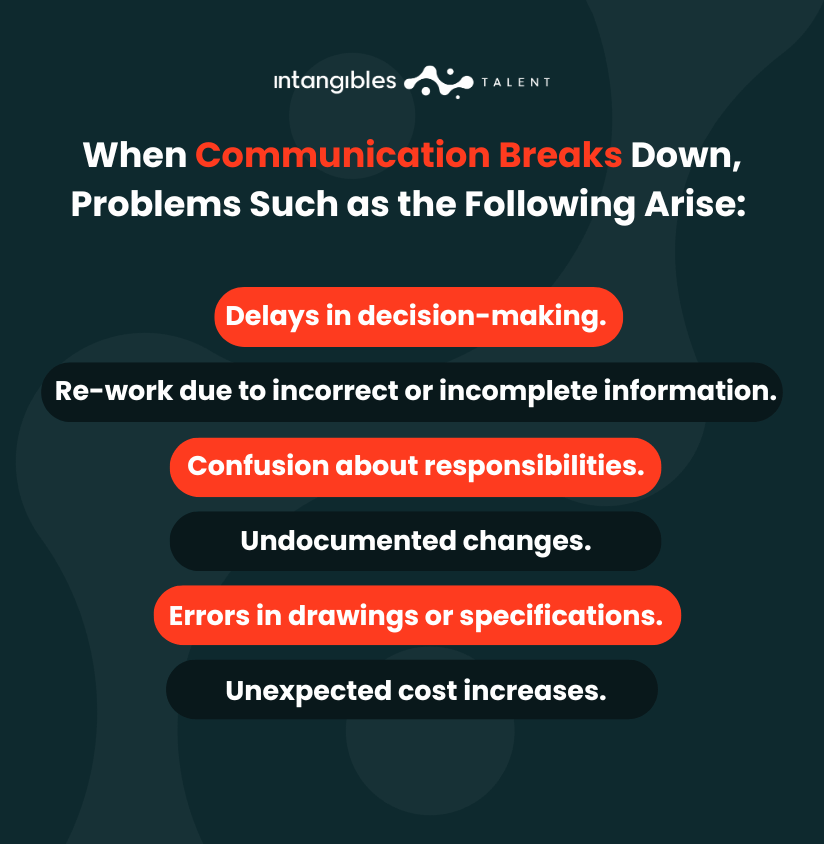
Even small misunderstandings can have significant impacts when they accumulate over the course of a project.
The 5 Most Costly Communication Failures in Construction Projects
1. Information Scattered Across Too Many Channels
When your team shares updates via text, email, phone calls, and three different apps simultaneously, critical information gets lost or contradicted.
Working from outdated drawings or superseded RFIs leads to incorrect installations, material waste, and disputes that eat into your margin. One source of truth, one centralized platform, eliminates this.
Tools commonly used by U.S. construction firms include Procore, Buildertrend, PlanGrid, Autodesk Construction Cloud, and Asana.
2. The Office-to-Field Disconnect
Changes approved in the trailer don’t always reach the crew doing the work. On average, field workers spend 5.5 hours per week searching for the information they need, and 48% of rework stems directly from poor data and communication.
Every hour a crew waits for updated instructions is money you can’t recover. Closing the gap between the office and the field is one of the highest-ROI investments a general contractor can make.
3. Unclear Roles and Responsibilities
When no one knows who owns a decision, no one makes it. Tasks fall through the cracks, approvals stall, and problems compound.
A clear RACI matrix, defining who is Responsible, Accountable, Consulted, and Informed on every task, prevents this. So does having a dedicated project coordinator whose sole job is keeping everyone aligned.
4. Insufficient documentation
Verbal conversations are quick, but they are also easy to forget or misinterpret; every important change but accessible to everyone involved.
Without proper documentation, it is difficult to:
- Resolve disputes.
- Verify approvals.
- Maintain project traceability.
5. Delays in sharing information
In construction, time is money. When it takes days to respond to a query or an update doesn’t arrive on time, crews may be left idle while waiting for instructions.
These periods of inactivity directly impact the project’s profitability.
How to Improve Communication on Construction Projects
The fix isn’t one single tool or policy. It’s a combination of systems, people, and habits that work together.
Centralizing your project data is the foundation. Every stakeholder, from the PM to the sub, should access the same up-to-date drawings, schedules, and RFIs from one platform. From there, written communication protocols define who submits RFIs, who approves change orders, and how field issues get escalated before they become problems.
Documentation discipline is equally critical. Decisions made verbally need to be confirmed in writing within 24 hours, protecting both the project and your business in the event of a dispute.
Structured coordination meetings close the loop. A 15-minute daily huddle between the office and the field prevents hours of rework. Weekly OAC meetings keep owners, architects, and contractors aligned before small misalignments turn into change orders.
And finally, the people. Project coordinators, estimators, pre-construction managers, and construction assistants are the connective tissue that keeps information flowing between departments. Without someone in that role, the systems alone won’t hold.
Why Communication Is a Competitive Advantage
Successful construction projects do not depend solely on accurate budgets or well-planned schedules.
They also depend on people’s ability to share information clearly, quickly, and effectively.
Companies that invest in better communication processes tend to experience fewer delays, fewer errors, and greater profitability in their projects.
If your company is looking to optimize coordination between teams, improve productivity, and reduce costs associated with communication failures, strengthening your internal processes could become one of the most profitable investments you make in 2026.
How Can Remote Talent Help with Construction Projects?
Remote professionals specializing in construction can support key areas such as estimating, pre-construction, project coordination, and management, allowing field teams to focus on execution.
At Intangibles Talent, we help construction companies in the United States and Canada bring on qualified talent who integrate into their processes to improve communication, organization, and operational efficiency.
Can remote professionals work effectively in construction? Yes, for administrative and coordination functions. Remote project coordinators manage RFIs, submittals, schedules, and documentation without needing to be on site, freeing your on-site team to focus on execution.
What’s the ROI of fixing communication in construction? Given that poor communication contributes to an average 28% budget overrun, even partial improvements in information flow can translate directly into margin recovery on every project.